The Science of Sourdough Bread - Understanding Fermentation
Explore the fascinating microbiology behind sourdough bread making and how wild yeast and bacteria create unique flavors through fermentation.
Dr. Jonathan Baker 5 min read
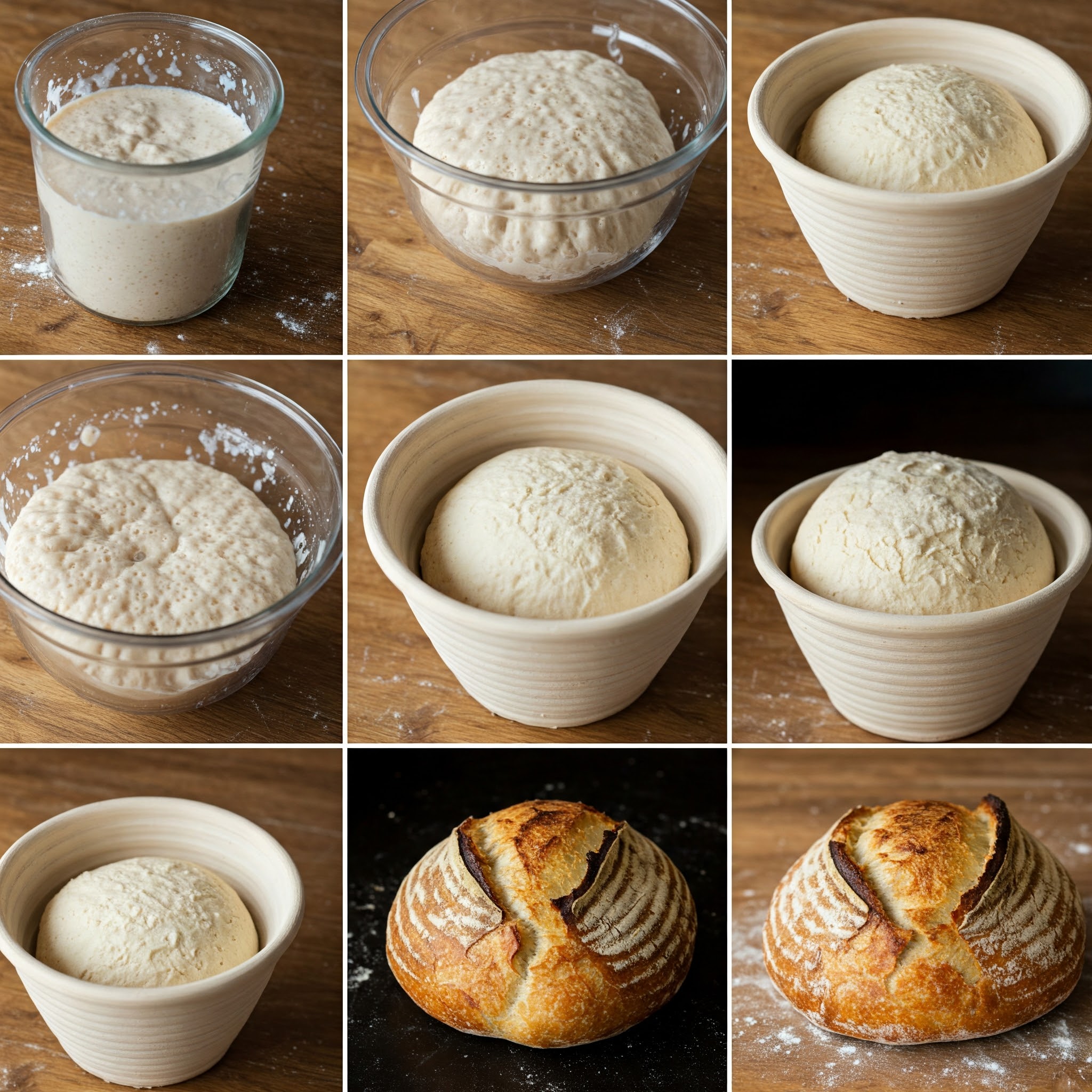
The Science of Sourdough Bread - Understanding Fermentation
"Bread is the staff of life, but sourdough is the poetry." - Unknown
In recent years, sourdough bread has experienced a remarkable renaissance, moving from artisanal bakeries into home kitchens worldwide. This ancient bread-making technique, dating back to at least 3700 BCE in Switzerland, relies on wild fermentation rather than commercial yeast. But what exactly happens during this fascinating biological process, and why does it create such distinctive flavors and textures? This article dives deep into the science of sourdough fermentation.
The Sourdough Starter: A Complex Ecosystem
At the heart of any sourdough bread is the starter (also called levain or mother) - a simple mixture of flour and water that captures wild yeasts and bacteria from the environment. This living culture becomes a complex ecosystem of microorganisms working in symbiotic harmony.
The primary microbes in a typical sourdough starter include:
- Wild Yeasts: Predominantly Saccharomyces cerevisiae and Candida humilis
- Lactic Acid Bacteria (LAB): Primarily from genera Lactobacillus, Leuconostoc, and Pediococcus
These microorganisms establish a remarkable balance in the starter. The mathematical expression for population growth in the starter can be modeled using the Lotka-Volterra equations:
$\(\frac{dN_1}{dt} = r_1N_1(1-\frac{N_1}{K_1}) - \alpha_1N_1N_2\)$ $\(\frac{dN_2}{dt} = r_2N_2(1-\frac{N_2}{K_2}) - \alpha_2N_1N_2\)$
Where:
- \(N_1\) and \(N_2\) are the populations of yeast and bacteria
- \(r_1\) and \(r_2\) are their respective growth rates
- \(K_1\) and \(K_2\) are their carrying capacities
- \(\alpha_1\) and \(\alpha_2\) represent interaction coefficients
The Biochemical Dance of Fermentation
When you combine your starter with fresh flour and water to make dough, you initiate a complex series of biochemical reactions. Let's examine the key processes:
1. Starch Breakdown
Amylase enzymes in the flour break down complex starches into simple sugars according to the reaction:
$\((C_6H_{10}O_5)<em>n + nH_2O \xrightarrow{\text{amylase}} nC_6H</em>{12}O_6\)$
2. Alcoholic Fermentation by Yeasts
Yeasts consume these simple sugars and produce carbon dioxide and ethanol:
$\(C_6H_{12}O_6 \xrightarrow{\text{yeast}} 2C_2H_5OH + 2CO_2 + \text{energy}\)$
The carbon dioxide bubbles create the characteristic holes in the bread, while the ethanol contributes to the aroma and mostly evaporates during baking.
3. Lactic Acid Fermentation by Bacteria
Simultaneously, lactic acid bacteria convert sugars into lactic acid and acetic acid:
$\(C_6H_{12}O_6 \xrightarrow{\text{LAB}} 2CH_3CHOHCOOH + \text{energy}\)$ $\(C_6H_{12}O_6 + O_2 \xrightarrow{\text{LAB}} CH_3COOH + CO_2 + H_2O + \text{energy}\)$
This microbial partnership creates a fascinating timeline of activity during fermentation:
pH Dynamics and Flavor Development
The acids produced by bacteria gradually lower the pH of the dough, typically reaching 3.8-4.5 in mature sourdough. This acidification is crucial for several reasons:
- Flavor development: The acidic environment produces complex flavor compounds
- Gluten modification: Acids alter gluten proteins, affecting texture and structure
- Preservation: Lower pH inhibits spoilage microorganisms
- Nutrient availability: Acidification activates phytase enzymes that break down phytic acid, increasing mineral bioavailability
The relationship between time and pH during fermentation follows a sigmoidal curve:
$\(pH(t) = pH_{initial} - \frac{A}{1 + e^{-k(t-t_m)}}\)$
Where:
- \(pH(t)\) is the pH at time \(t\)
- \(pH_{initial}\) is the starting pH
- \(A\) is the maximum pH drop
- \(k\) is the rate constant
- \(t_m\) is the time of maximum rate of change
The Role of Temperature in Fermentation
Temperature dramatically affects the activity of microorganisms in sourdough. Consider the following table showing optimal temperatures for different processes:
| Process | Optimal Temperature Range | Primary Result |
|---|---|---|
| Yeast activity | 25°C - 28°C (77°F - 82°F) | Maximum CO₂ production |
| LAB activity | 32°C - 35°C (90°F - 95°F) | Maximum acid production |
| Flavor development | 4°C - 7°C (39°F - 45°F) | Complex flavors during long fermentation |
| Gluten development | 24°C - 26°C (75°F - 79°F) | Optimal dough strength |
The temperature coefficient (Q₁₀) for metabolic reactions in sourdough microorganisms is approximately 2, meaning reaction rates double with every 10°C increase in temperature. This relationship can be expressed as:
$\(k_2 = k_1 \cdot Q_{10}^{\frac{T_2 - T_1}{10}}\)$
Where:
- \(k_1\) and \(k_2\) are the reaction rates at temperatures \(T_1\) and \(T_2\)
- \(Q_{10}\) is the temperature coefficient
Gluten Development and Dough Structure
Beyond fermentation, the development of the gluten network is essential for creating the characteristic structure of sourdough bread. Gluten proteins (glutenin and gliadin) form complex networks that trap the carbon dioxide produced by yeast.
The acidic environment created by lactic acid bacteria affects gluten in several ways:
- Enhances water absorption capacity
- Increases elasticity while reducing extensibility
- Strengthens the protein network through additional hydrogen bonding
The viscoelastic properties of dough can be described using the Maxwell model:
$\(\frac{d\epsilon}{dt} = \frac{\sigma}{\eta} + \frac{1}{E}\frac{d\sigma}{dt}\)$
Where:
- \(\epsilon\) is strain
- \(\sigma\) is stress
- \(\eta\) is viscosity
- \(E\) is the elastic modulus
Health Benefits of Sourdough Fermentation
Sourdough fermentation does more than create delicious bread; it also offers numerous health benefits:
- Reduced gluten content: Proteolytic enzymes partially break down gluten proteins
- Lower glycemic index: The acidity slows starch digestion, resulting in more stable blood sugar levels
- Increased mineral availability: Phytase enzymes break down phytic acid, which otherwise binds minerals
- Prebiotic compounds: Fermentation produces exopolysaccharides that feed beneficial gut bacteria
- Reduced antinutrients: Fermentation decreases levels of enzyme inhibitors and lectins
The prebiotic potential of sourdough can be quantified through its content of fructans and resistant starch, which typically increases by 30-45% compared to conventional bread.
Conclusion
Sourdough bread is a perfect example of how ancient food traditions often contain profound scientific wisdom. The complex microbial ecosystem of sourdough creates a unique product that not only tastes remarkable but also offers improved digestibility and nutrition. As we continue to study the intricate biochemistry of sourdough, we gain deeper appreciation for this amazing process that transforms simple flour and water into one of humanity's most beloved foods.
"To understand the chemistry of baking is interesting, but to experience the alchemy of sourdough is transformative." - Chad Robertson, Tartine Bakery
This article explores the fascinating science behind sourdough fermentation, blending microbiology, biochemistry, and food science to explain this ancient bread-making technique. From the complex ecosystem of wild yeasts and bacteria to the biochemical reactions that create flavors and textures, sourdough bread represents a perfect marriage of tradition and science.