Exploring Dark Sky Tourism - The Rise of Astrotourism
Discover the growing trend of dark sky tourism, including top destinations, astrophotography techniques, and how this form of sustainable tourism is preserving natural darkness worldwide.
Dr. Elena Ramirez 7 min read
Exploring Dark Sky Tourism - The Rise of Astrotourism
"The night sky is the most universally accessible wonder of our natural world." - Paul Bogard
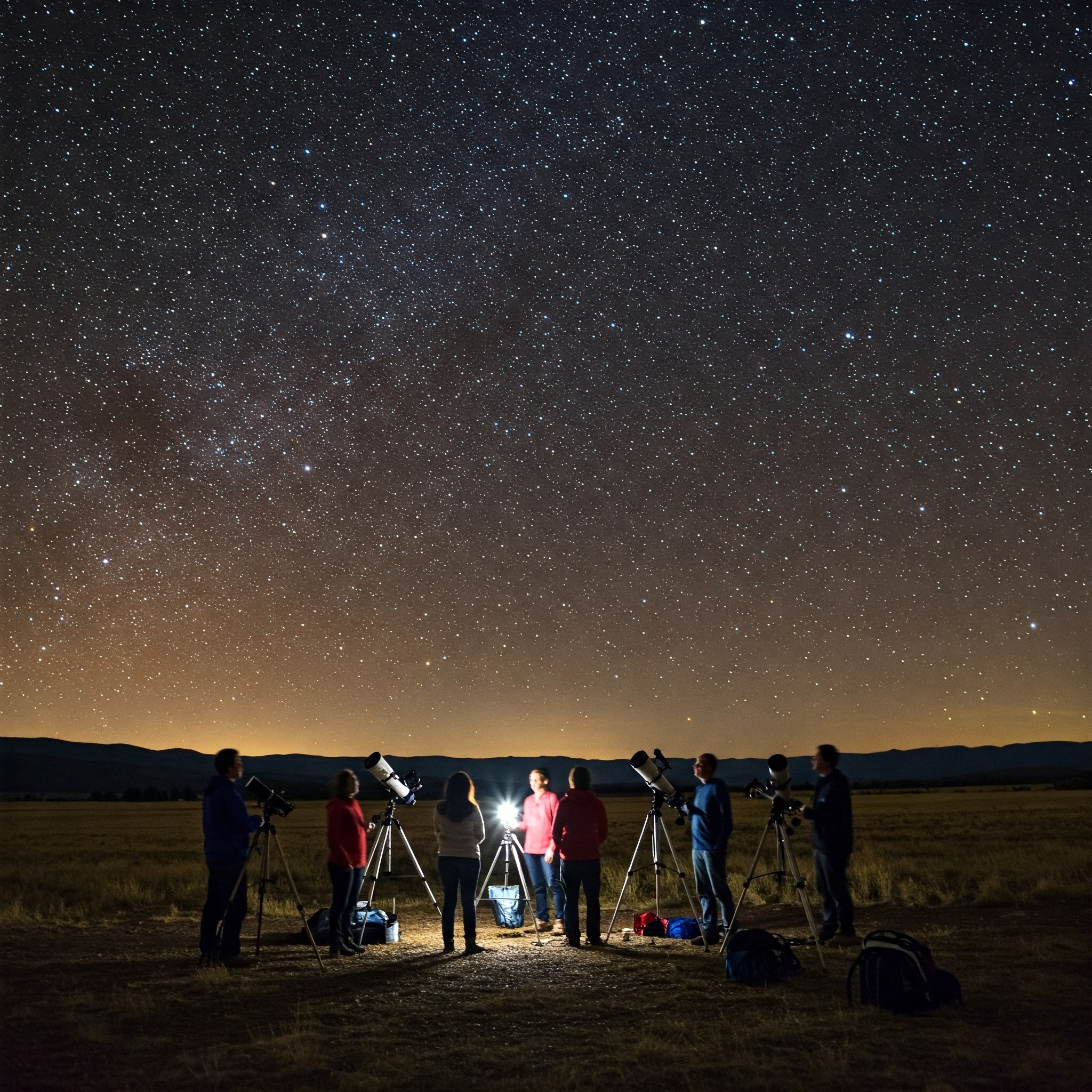
In an increasingly illuminated world, truly dark night skies have become a rare and precious resource. This scarcity has given rise to a specialized form of ecotourism known as dark sky tourism or astrotourism - travel specifically motivated by the desire to experience pristine night skies and celestial phenomena. This comprehensive guide explores the science, geography, photography techniques, and conservation aspects of this growing tourism niche.
The Light Pollution Crisis
Before discussing dark sky destinations, it's crucial to understand what we're losing. Light pollution - the excessive or inappropriate use of artificial light - has rapidly expanded across the globe, with significant ecological, health, and cultural consequences.
The Bortle Scale quantifies night sky quality from Class 1 (excellent dark-sky site) to Class 9 (inner-city sky). Most urban dwellers live under skies rated Class 7-9, where only a few dozen stars are visible. In contrast, a truly dark site (Class 1-2) reveals thousands of stars, the detailed structure of the Milky Way, and numerous deep-sky objects visible to the naked eye.
The mathematical model for calculating sky brightness (in magnitudes per square arcsecond) at a given distance from light sources follows:
$\(V = V_{\text{natural}} - 2.5 \log_{10}\left(1 + \frac{I \times F(\theta) \times e^{-kR}}{R^2 \times V_{\text{natural}} \times 10^{-0.4M}}\right)\)$
Where:
- \(V\) = resulting sky brightness
- \(V_{\text{natural}}\) = natural sky brightness
- \(I\) = light source intensity
- \(F(\theta)\) = angular distribution function
- \(k\) = atmospheric extinction coefficient
- \(R\) = distance from source
- \(M\) = zenith angle correction
This formula explains why traveling hundreds of kilometers from major cities is often necessary to experience truly dark skies.
International Dark Sky Places
The International Dark-Sky Association (IDA) certifies locations that preserve exceptional night skies through responsible lighting practices and education. These designated areas form the backbone of dark sky tourism infrastructure:
| Designation Type | Number Worldwide | Requirements |
|---|---|---|
| Dark Sky Parks | 195+ | Public land with exceptional starry nights |
| Dark Sky Reserves | 21+ | Core dark area surrounded by communities committed to protecting it |
| Dark Sky Sanctuaries | 18+ | Most remote and darkest places with limited facilities |
| Dark Sky Communities | 39+ | Towns and cities with exemplary lighting policies |
Premier Global Astrotourism Destinations
Natural Astronomy Amphitheaters
Certain landscapes provide natural advantages for stargazing:
-
Desert Environments
- NamibRand Nature Reserve, Namibia (Africa's first Dark Sky Reserve)
- Atacama Desert, Chile (Home to major observatories with <25 mm annual rainfall)
- Death Valley National Park, USA (The largest Dark Sky Park)
-
Island Destinations
- La Palma, Canary Islands (Protected by specific "Sky Law")
- Aotea/Great Barrier Island, New Zealand (World's first island Dark Sky Sanctuary)
- Alqueva Dark Sky Reserve, Portugal (Encompassing a massive artificial lake)
-
Mountain Observatories
- Mauna Kea, Hawaii (4,207m elevation with exceptional seeing conditions)
- Mount Teide, Tenerife (Home to Instituto de Astrofísica de Canarias)
- Pic du Midi, French Pyrenees (Historic observatory now open to tourists)
The quality of astronomical seeing at these sites can be quantified using the Fried parameter (\(r_0\)), which represents the diameter of a telescope that would produce diffraction-limited images in the presence of atmospheric turbulence:
$\(r_0 = \left( 0.423 k^2 \sec(\zeta) \int_{0}^{\infty} C_n^2(h) dh \right)^{-3/5}\)$
Where:
- \(k\) = wave number
- \(\zeta\) = zenith angle
- \(C_n^2(h)\) = refractive index structure constant at height \(h\)
Premier observing sites like Mauna Kea or Paranal Observatory in Chile can achieve \(r_0\) values of 20+ cm, compared to 5-10 cm at typical locations.
The Celestial Calendar: Timing Your Astrotourism Visit
Strategic timing dramatically enhances dark sky experiences:
Annual Meteor Showers
| Shower | Peak Dates | Typical ZHR* | Parent Body |
|---|---|---|---|
| Perseids | August 11-13 | 100 | Comet Swift-Tuttle |
| Geminids | December 13-14 | 150 | Asteroid 3200 Phaethon |
| Quadrantids | January 3-4 | 120 | Asteroid 2003 EH₁ |
| Leonids | November 17-18 | 15+ | Comet 55P/Tempel-Tuttle |
*ZHR = Zenith Hourly Rate (theoretical maximum under perfect conditions)
Solar Eclipses and Aurora Forecasting
Total solar eclipses follow mathematically predictable paths years in advance, creating focused tourism events. The duration of totality at a given location can be calculated using:
$\(T = \frac{2\sqrt{(R_s - R_m)^2 - d^2 \cos^2(\beta)}}{v \sin(\alpha)}\)$
Where:
- \(T\) = duration of totality
- \(R_s\) = radius of the sun's shadow
- \(R_m\) = radius of the moon
- \(d\) = distance from observer to center of eclipse path
- \(\beta\) = eclipse path inclination
- \(v\) = shadow velocity
- \(\alpha\) = angle between shadow motion and Earth's surface
For aurora viewing, the Kp-index (range 0-9) measures geomagnetic activity, with aurora becoming visible at mid-latitudes when Kp≥5. Prediction models incorporate solar wind parameters and interplanetary magnetic field data to forecast aurora likelihood up to 72 hours ahead.
Astrophotography Techniques for Travelers
The democratization of digital photography has made capturing the night sky accessible to travelers. Key techniques include:
Wide-Field Milky Way Photography
For capturing the Milky Way, exposure time must be limited to prevent star trailing. The "500 Rule" provides a guideline:
$\(\text{Maximum Exposure (seconds)} = \frac{500}{\text{Focal Length} \times \text{Crop Factor}}\)$
A more precise formula accounting for sensor resolution and declination is:
$\(t = \frac{100 \times N_p}{f \times \cos(\delta) \times \pi \times 3600}\)$
Where:
- \(t\) = maximum exposure time in seconds
- \(N_p\) = pixel size in microns
- \(f\) = focal length in mm
- \(\delta\) = declination of the target area
Recommended starting settings:
- Aperture: f/2.8 or wider
- ISO: 1600-6400
- White Balance: 3700-4000K
- Focus: Manual infinity (with fine-tuning)
Deep-Sky Astrophotography
For capturing distant galaxies, nebulae, and star clusters, multiple tracked exposures are integrated to improve signal-to-noise ratio according to:
$\(\text{SNR} \propto \sqrt{N}\)$
Where \(N\) is the number of stacked exposures. This technique, known as integration, improves image quality by reducing random noise while preserving signal.
Light Pollution Reduction Techniques
Even at dark sky destinations, knowledge of filtration technologies enhances results:
- Narrowband Filters - Isolate specific emission lines from nebulae
- Light Pollution Suppression Filters - Block common artificial light wavelengths
- Image Processing - Techniques like gradient removal and color calibration
The Sustainable Economics of Dark Sky Tourism
Dark sky tourism creates sustainable economic incentives for night sky preservation. The economic impact follows:
$\(\text{Total Economic Impact} = \text{Direct Spending} + \text{Indirect Spending} + \text{Induced Spending}\)$
Case studies demonstrate significant benefits:
- Galloway Forest Dark Sky Park (Scotland): £600,000+ annual economic impact
- Bryce Canyon National Park (USA): $200 million annual economic impact with stargazing programs as a major driver
- NamibRand Nature Reserve (Namibia): 30% increase in off-season occupancy after Dark Sky certification
The Science of Dark Sky Preservation
Protecting dark skies requires evidence-based approaches to outdoor lighting. The environmental impact of lighting depends on multiple factors quantified in the following equation:
$\(\text{Ecological Impact} \propto I \times A \times D \times S\)$
Where:
- \(I\) = intensity of light
- \(A\) = spectral distribution (blue content)
- \(D\) = duration of exposure
- \(S\) = species sensitivity factor
This has led to the development of best practices for dark-sky friendly lighting:
- Shielding - Full cut-off fixtures that direct light downward
- Spectral Management - Using amber/warm sources with limited blue emission
- Adaptive Controls - Dimming or turning off lights when not needed
- Appropriate Illumination Levels - Using minimum necessary brightness
The International Commission on Illumination (CIE) provides scientific guidance through publications like CIE 150, which establishes environmental zones from E0 (intrinsically dark) to E4 (high brightness urban areas) with corresponding illumination limits.
Psychological Benefits of Dark Sky Experiences
Beyond the visual spectacle, exposure to natural darkness offers documented psychological benefits:
- Awe and Perspective - Stellar distances provide a cosmic perspective on human concerns
- Circadian Regulation - Natural darkness exposure helps reset disrupted circadian rhythms
- Cognitive Restoration - Night sky viewing meets criteria for Attention Restoration Theory
- Connection to Cultural Heritage - Rekindling historical relationships with celestial navigation
Research suggests that experiences of awe—common during dark sky experiences—correlate with increased prosocial behavior, reduced materialism, and enhanced well-being.
Conclusion: The Future of Darkness
As artificial light continues to encroach on the natural night, dark sky tourism represents both a warning and an opportunity. By creating economic value around astronomical experiences, communities worldwide are finding that darkness itself can be a precious resource worth preserving. For travelers, the journey to dark skies offers not just spectacular views, but a reconnection with humanity's oldest natural wonder.
"We need darkness as much as we need light. One is meaningless without the other." - Nancy Hathaway
Whether you're planning a dedicated astrophotography expedition or simply incorporating stargazing into your next wilderness trip, the night sky offers a dimension of travel that remains profoundly moving in our increasingly digital age. By supporting dark sky destinations, travelers contribute to a movement that recognizes the value of the cosmos not just as a scientific laboratory, but as a shared cultural heritage that deserves protection.
This comprehensive guide to dark sky tourism covers the scientific, geographical, photographic, and conservation aspects of astrotourism. From explaining light pollution's technical aspects to identifying premier stargazing destinations, it provides both practical travel information and deeper context about why natural darkness matters in our increasingly illuminated world.